Tech Talk Forum home - Go back to Tech talk
|
Quick fixes
|
|
|
|
|

|
Location: Hill Top, NSW
Member since 18 September 2015
Member #: 1801
Postcount: 2265
|
Quick fix no 5
My very first radio, given to me by a teacher when I was a high school student. Original valves: 6BH5, 6AN7, 6BH5, 6AL5, EF86, 12AU7, 6M5, 6M5, EM84, EZ80. However I have made changes over the years, and now it has 6BH5, 6AN7, 6BH5, 6AL5, EF86, 12AX7, 6BQ5, 6BQ5, EM84, 6CA4 in the ultra-linear configuration.
The problem was when first turned on it was rather loud and then after about 10 minutes it would drop to the correct volume. When placed on the bench of course it worked correctly. So I brought it back, and now it didn't work at all, with the EM84 fully alight. Back to the bench again, and it took a while to find the AGC filter cap was broken in half, but that wasn't noticeable until it was touched. Once replaced, the radio worked again.
The ultra-linear circuit takes negative feedback from the speaker to maintain a good frequency response, and poking around the speaker socket uncovered dry joints on the feedback components. So now hopefully there won't be any more volume variations.
The last problem which I haven't addressed yet is a hum, which means replacing the main electros, as the originals are still there. Unfortunately there's not much room, and they don't make replacement chassis-mounted types any more as far as I know. Something for another day.
|
|
|
|
|

|
Administrator
Location: Naremburn, NSW
Member since 15 November 2005
Member #: 1
Postcount: 7646
|
I disconnect both leads on chassis mounted caps and replace them with standard 600V ones at as close to the correct capacity as possible. I'll usually leave the old one mounted in its original position to stop wandering fingers accessing "the works" underneath.
‾‾‾‾‾‾‾‾‾‾‾‾‾‾‾‾‾‾‾‾‾‾‾‾‾‾‾‾‾‾‾‾‾‾‾‾‾‾‾‾‾‾‾‾‾‾‾‾‾‾‾‾‾‾‾‾‾‾‾‾‾‾‾‾‾‾‾‾
A valve a day keeps the transistor away...
|
|
|
|
|
|
|
Location: Hill Top, NSW
Member since 18 September 2015
Member #: 1801
Postcount: 2265
|
Quick fix no 6
Not a valve radio, but a stereo cassette deck from the 80s. These also need saving, as long as you have cassettes that still work.
This one is a Marantz 5010B, which looks expensive.
A long time ago I had fixed the mechanical issues with playing tapes etc, but after being in storage for a while, it now had more issues. The main one was when Play was pressed, the meter (sometimes both, other times just the Right channel) would fly to full scale and keep bouncing hard enough to make an audible sound. So, was it the power supply? or some electrolytic somewhere?
I downloaded the service manual, which has a schematic. Then I used the meter on AC volts to trace the signal from the output back through the stages, until I arrived at the playback head. Now the important thing with any cassette player is that the record/play switch changes which side of the head is earthed. But what happens if it isn't? Being at the start of the amplifier chain means it goes berzerk. So a bit of cleaner sprayed into the switch fixed the problem. I suppose it's obvious in hindsight, but not straight away.
While I was there a drop of oil was used to fix the door opening rather slowly, and another to fix the very stiff record button.
To test, I found a plug that converts the big stereo headphone jack to the smaller size used these days. Then I plugged in a set of computer soundblaster speakers, played a tape, and it worked quite well. Just shows that you don't even need an amplifier, the computer speakers do a good job.
|
|
|
|
|

|
Location: Wangaratta, VIC
Member since 21 February 2009
Member #: 438
Postcount: 5738
|
Not common but the "swishing" may be "squegging". that can occur in the oscillator injection and in many sets there is a resistor around 27 ohms in series with the injection as an "anti resonance" device.
I still see mistakes, like wire wound resistor replacements in the RF and a failure to replace all electrolytic caps and factory dry joints missed.
|
|
|
|
|
|
|
Location: Hill Top, NSW
Member since 18 September 2015
Member #: 1801
Postcount: 2265
|
Quick fix no 7
This radio is a Radiola with the usual 7-pin valves. It's hard to make out the model number but I think it says 539MA.
The problem was when tuned to my station the sound was completely distorted. After putting it on the bench there was a hum which I somehow hadn't noticed before. Measuring the AC levels showed that the 2nd electro wasn't doing its job, with about 5 volts there. I replaced it and now there was 0.03 volts. A big improvement. Next to it was a 2.7M resistor connecting the audio to the AGC, this resistor had gone high so it was also replaced.
Turning on showed the hum completely gone, and most of the distortion too. A quick tuneup to get the AGC voltage up sorted that out.
The last thing was to replace a blown bulb, normally a trivial task, but this radio uses those dreadful spring sockets, which unbelievably are a permanent part of the front panel. Of course both bulbs were stuck to their sockets due to the usual metal migration. I carefully used a screwdriver to prise out the blown bulb without breaking the spring. The bulb disintegrated as expected, but since it was already blown, who cares. I decided to try spraying WD40 on the new bulb's thread in the hope it might reduce future problems, then put it in. It lights up at least.
Put the case on and it sounds pretty good now.
|
|
|
|
|

|
Location: Toongabbie, NSW
Member since 19 November 2015
Member #: 1828
Postcount: 1415
|
Hi Rob, I keep up with your set fixes.
Find it entertaining.
Keep going!
Fred.
|
|
|
|
|
|
|
Location: Hill Top, NSW
Member since 18 September 2015
Member #: 1801
Postcount: 2265
|
Quick fix no 8
This is the "Success" set that was referred to in another thread, and there's pictures of it somewhere on this forum too. It's the set that was missing a 2A5.
First thing was to look at the friction tuning. I worked out how to remove the tuning and dial from the radio. After cleaning the grease and grime, it's obvious the thing is clapped out, but it still worked, just. However the 3-gang variable tuning capacitor has noticeable friction, and it's this that prevents it all from working. Usually a drop or two of oil will loosen the tuner, but that didn't happen with this one. Oh well. So I manually pushed it to tune into my house station and left it there.
The radio itself works fine. Valves: 58, 57, 58, 2A6, 2A5, 80. These are the same as various octal valves, but with a 2.5 volt heater and the ancient 4,5,6,7-pin sockets. 58 = 6D6 = 6U7G, 57 = 6J7G, 2A6 = 6B6G, 2A5 = 6F6G, 80 = 5Y3G. The 57, a pentode, is used as the frequency changer. I have no idea how that works, but it obviously does, and it works well.
The original speaker was an electrodynamic type, but that wasn't in the radio when received. So, years ago I had mounted a choke on the back, and used an ordinary speaker with transformer mounted on it just loose in the bottom of the cabinet. But now, I wanted to use a 12 inch speaker, mounted properly. I already had a suitable front support, so now I screwed it in place. Out of my 4 spare 12 inch speakers, one had a transformer already on it, a Rola 12M. At this point I forgot a step. The original speaker used a 5-pin plug into the back, so I soldered the plug onto the Rola 12M, screwed it in, switched on, and... nothing?
Now I did what I should have done before, and check that the speaker actually worked. This showed that it didn't, as one of the copper braids was entirely missing, and the wire to the voice coil was missing too. So that speaker was no use. I then used a Rola 12-O, this has the bracket for the transformer, but none was ever fitted. I drilled off the transformer from the 12M and screwed it onto the 12-O. The carcass of the 12M went to the bin. A pity, as the cone was intact, no holes.
So, the 12-O was mounted, and switching on produced music. I let it run all afternoon, and it works very well, without needing any antenna wire. Not bad for mid-late 1930s tech. It makes a lot of volume too.
The last thing to do, is to find some screws to keep the chassis in place, and find a knob for the volume control. I won't bother about the tuning (since it doesn't work), and the tone (never need to adjust it).
A word of warning for anyone working on one of these. The HT is a lethal 360 volts. If the 2A5 is missing, then we are talking 430 volts.
|
|
|
|
|
|
|
Location: Wangaratta, VIC
Member since 21 February 2009
Member #: 438
Postcount: 5738
|
It is often forgotten, or not realised that where there is a filament rectifier with no cathode sleeve, or rectifiers that behave like one, or he HT somehow goes open circuit, The surge voltage will in the majority of cases close to double its running voltage. Underrated caps are then in peril.
The most recent clearing sale fixer that landed here for no sound, had the principal problem diagnosed before it made it to the workshop. The speaker cone was the mouse nest on the inside of the chassis.
|
|
|
|
|
|
|
Location: Toongabbie, NSW
Member since 19 November 2015
Member #: 1828
Postcount: 1415
|
Hi Rob, enjoy reading your efforts.
The 2A5 set fix#8 sounds like it has an 'autodyne' front end.
That uses a pentode , the 57, to do both the oscillating and mixing.
It saved them using a more expensive pentagrid and still works fine on the AM band.
I did a lot of work investigating the autodyne somewhere in 'special projects'.
They had to shift to a proper pentagrid mixer to use with short wave and that was the end of the autodyne idea.
Fred.
|
|
|
|
|
|
|
Location: Hill Top, NSW
Member since 18 September 2015
Member #: 1801
Postcount: 2265
|
Quick fix #9
Decided to revisit the HMV J6 transistor radio that looks just like the old valve Super-5. I had purchased parts to fix it years ago and never got around to it.
The first thing was on the ferrite rod there was a grommet made of rubber enclosed in an aluminium ring. It fell off and the sensitivity increased. I realised that the grommet should be all rubber, as the metal ring was acting as a shorted turn. I found a suitable grommet and that problem was fixed.
The main issue is that the local osc drops out (or nearly out) in the 1260 to 1420 kHz range of the dial. Why this range? No idea. Originally I thought my house station was overloading it, but the problem still happened with the station switched off. I replaced a number of ceramic 47n caps with new ones, also replaced the 22uF/3v electro on the AGC line. This improved things, but the basic issue is still there somewhat. Sometimes it completely blanks reception, and sometimes it just reduces the sensitivity.
Another problem I noticed is quite poor sensitivity at the lower end of the band. Normally you'd slide the coil on the ferrite rod to a better position, but this one is stuck on with a very tough glue, and I don't want to attack it due to the damage it would cause.
So, in the end, not really fixed, but it is working much better than before.
|
|
|
|
|
|
|
Location: Hill Top, NSW
Member since 18 September 2015
Member #: 1801
Postcount: 2265
|
Number 10. Not a fix.
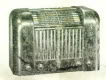
There was a HMV Little Nipper, model number unknown. Valves: 6A8G, 6X5GT, EBF35, EL33.
The tuning control has a rubber wheel on the shaft. This rubs on the edge of the tuning wheel. This in turn has the cord to move the dial pointer. The problem is that the rubber has gone rotten, and it is also slipping on the shaft. No chance of a replacement.
The sound is distorted, as if the speaker is crook. The case fell to bits when I opened it. The volume control is worn out. The ancient electros seem ok, going by the AC voltages, but there's still a hum. The resistors are really old, and I suspect all the AGC parts need replacement.
The chassis is odd, a U shape, with 2 valves upside-down. There's 2 white knobs, one for volume, one for tuning. There's a small white slide switch for the tone - well it looks like a slide switch, but inside it's a lever that one end touches a piece of spring steel to connect a capacitor to ground.
I suppose I could do all the work needed, but I'm tired, can no longer be bothered. So it's in the scrap pile now.
If anyone knows the model number, I'd be interested to know.
|
|
|
|
|
|
Location: Sydney, NSW
Member since 28 January 2011
Member #: 823
Postcount: 6971
|
|
|
|
|
|
|
|
Location: Wangaratta, VIC
Member since 21 February 2009
Member #: 438
Postcount: 5738
|
I see a couple of technical flaws here. One is that the mechanical alignment of the dial should be checked before messing with adjustments. They can move, especially if their retention, like rubber, fails with time.
Often the coil on a ferrite rod will slip, not helpful and some petty dodgy methods were used to hold them in place.
HMV and others clamped the ferrite antenna rod with a "C" shaped clamp. If you close that, so it forms a circle. That's a shorted turn and attenuation of the signal guaranteed.
|
|
|
|
|
|
|
Location: Hill Top, NSW
Member since 18 September 2015
Member #: 1801
Postcount: 2265
|
Thanks GTC, that does indeed look like the one, except mine is white (what they call cream). The knobs are also white and are rounded, different to what's in the photo. It actually looks quite nice (or did before it fell apart), but the plastic is quite fragile.
|
|
|
|
|
|
|
Location: Wangaratta, VIC
Member since 21 February 2009
Member #: 438
Postcount: 5738
|
I have mentioned many times, in relation to conservation, that some of the older plastics have not turned out to be the wonder material they imagined it to be.
Knobs with necks, tend to fatigue crack & break, some plastic decomposes and that tends to be prevalent in coil formers. As mentioned before, self tapping screws in plastic often crack it. I have had a couple of "beehive" sets where warping has caused issues with the 3/16" threads. I did over come that carefully, with taps & dies and fitting fibre washers.
|
|
|
|
|
|
You need to be a member to post comments on this forum.
|

|
|

