
General Discussion
Forum home - Go back to General discussion
|
A begging letter from the shakey isles.
|
|
|
« Back ·
1 ·
Next »
|
|
|
Return to top of page · Post #: 1 · Written at 8:40:38 AM on 7 August 2026.
|
|

|
Location: Wellington, NZ
Member since 24 July 2009 Member #: 517 Postcount: 68 |
|
Tena Koe, greetings from NZ. 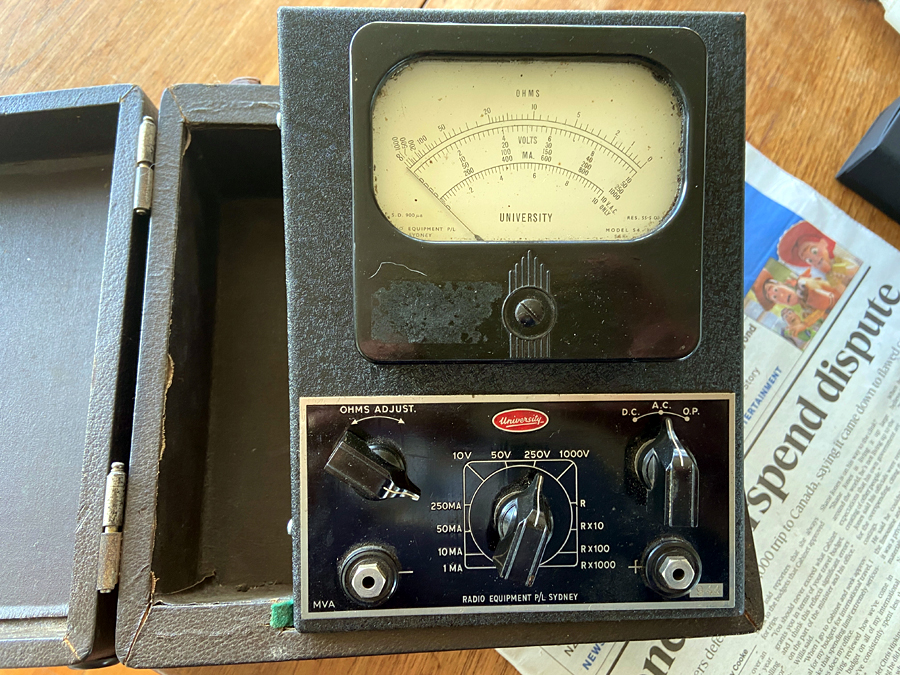 ‾‾‾‾‾‾‾‾‾‾‾‾‾‾‾‾‾‾‾‾‾‾‾‾‾‾‾‾‾‾‾‾‾‾‾‾‾‾‾‾‾‾‾‾‾‾‾‾‾‾‾‾‾‾‾‾‾‾‾‾‾‾‾‾‾‾‾‾ 6A8G. |
|
|
Return to top of page · Post #: 2 · Written at 8:13:46 PM on 7 August 2026.
|
|

|
Location: Wangaratta, VIC
Member since 21 February 2009 Member #: 438 Postcount: 5747 |
|
Circuit diagrams for meters can be rare. Photo may be useful. There may be capacitors in it and in AVO 7x, Peak meters, & others, I have found plenty faulty. |
|
|
Return to top of page · Post #: 3 · Written at 8:20:54 PM on 7 August 2026.
|
|
|
|
Location: Wellington, NZ
Member since 24 July 2009 Member #: 517 Postcount: 68 |
|
Ohh yes, it was in the AC mode😄 & I did a careful inspection. I’ve emailed a snap to Brad. ‾‾‾‾‾‾‾‾‾‾‾‾‾‾‾‾‾‾‾‾‾‾‾‾‾‾‾‾‾‾‾‾‾‾‾‾‾‾‾‾‾‾‾‾‾‾‾‾‾‾‾‾‾‾‾‾‾‾‾‾‾‾‾‾‾‾‾‾ 6A8G. |
|
|
Return to top of page · Post #: 4 · Written at 8:39:59 PM on 7 August 2026.
|
|
|
|
Location: Wangaratta, VIC
Member since 21 February 2009 Member #: 438 Postcount: 5747 |
|
Those old meters of which I have a few types are also very prone to verdigris etc and that type of brass etc. does need cleaning. Kevin Chants site has some limited University info. Circuitry in many of those is quite basic & easily but tediously, reverse engineered. |
|
|
Return to top of page · Post #: 5 · Written at 3:12:47 PM on 8 August 2026.
|
|

|
Administrator
Location: Naremburn, NSW
Member since 15 November 2005 Member #: 1 Postcount: 7661 |
|
Photo is uploaded. ‾‾‾‾‾‾‾‾‾‾‾‾‾‾‾‾‾‾‾‾‾‾‾‾‾‾‾‾‾‾‾‾‾‾‾‾‾‾‾‾‾‾‾‾‾‾‾‾‾‾‾‾‾‾‾‾‾‾‾‾‾‾‾‾‾‾‾‾ A valve a day keeps the transistor away... |
|
|
Return to top of page · Post #: 6 · Written at 6:24:22 PM on 8 August 2026.
|
|
|
Location: Sydney, NSW
Member since 28 January 2011 Member #: 823 Postcount: 6979 |
|
I don't know the model number of that meter, but it's featured on University Paton's history page:
|
|
|
Return to top of page · Post #: 7 · Written at 8:44:07 AM on 9 August 2026.
|
|

|
Location: Toongabbie, NSW
Member since 19 November 2015 Member #: 1828 Postcount: 1416 |
|
Hi John! |
|
|
Return to top of page · Post #: 8 · Written at 11:06:48 AM on 9 August 2026.
|
|
|
|
Location: Wangaratta, VIC
Member since 21 February 2009 Member #: 438 Postcount: 5747 |
|
A new Silicon Diode with a voltage like 1000V plus, depending as to where it is electrically; will be more efficient & require recalibration. EHT on my Heathkit Oscilloscope gained, and needed to have tamed an extra few hundred volts after the Selenium stick rectifier failed & was replaced with a TV diode. |
|
|
Return to top of page · Post #: 9 · Written at 6:15:41 AM on 10 August 2026.
|
|
|
|
Location: Wellington, NZ
Member since 24 July 2009 Member #: 517 Postcount: 68 |
|
‾‾‾‾‾‾‾‾‾‾‾‾‾‾‾‾‾‾‾‾‾‾‾‾‾‾‾‾‾‾‾‾‾‾‾‾‾‾‾‾‾‾‾‾‾‾‾‾‾‾‾‾‾‾‾‾‾‾‾‾‾‾‾‾‾‾‾‾ 6A8G. |
|
|
Return to top of page · Post #: 10 · Written at 12:24:26 AM on 11 August 2026.
|
|
|
|
Location: Wangaratta, VIC
Member since 21 February 2009 Member #: 438 Postcount: 5747 |
|
Most of the ordinary meters perhaps have an issue left on ohms: However, never a good idea. Most of the meters that are liable chomp batteries, or run on the mains, will have an off switch. |
|
|
Return to top of page · Post #: 11 · Written at 3:45:47 AM on 11 August 2026.
|
|
|
|
Location: Sydney, NSW
Member since 28 January 2011 Member #: 823 Postcount: 6979 |
|
OK, thanks to this new post we see that the "MVA" on the panel is in fact the model: |
|
|
Return to top of page · Post #: 12 · Written at 9:20:32 PM on 12 August 2026.
|
|
|
|
Location: Wangaratta, VIC
Member since 21 February 2009 Member #: 438 Postcount: 5747 |
|
I note MVA-2 is showing a full wave rectifier. That really has to be replace with same, if faulty. Small block ones are made. It would pay to have the one in it identified (photo) to see what it might be? |
|
|
Return to top of page · Post #: 13 · Written at 5:42:21 AM on 18 August 2026.
|
|
|
|
Location: Wellington, NZ
Member since 24 July 2009 Member #: 517 Postcount: 68 |
|
Gentlemen, thanx so much. & nice to see someone else with the same beastie, complete with the manual. I'll get to play around with mine as time dictates. ‾‾‾‾‾‾‾‾‾‾‾‾‾‾‾‾‾‾‾‾‾‾‾‾‾‾‾‾‾‾‾‾‾‾‾‾‾‾‾‾‾‾‾‾‾‾‾‾‾‾‾‾‾‾‾‾‾‾‾‾‾‾‾‾‾‾‾‾ 6A8G. |
|
|
« Back ·
1 ·
Next »
|
|
|
You need to be a member to post comments on this forum.
|
|
 GTC, the number is 944. I'll have a look at the Paton page too!

Sign In

Vintage Radio and Television is proudly brought to you by an era where things were built with pride and made to last.
DISCLAIMER: Valve radios and televisions contain voltages that can deliver lethal shocks. You should not attempt to work on a valve radio or other electrical appliances unless you know exactly what you are doing and have gained some experience with electronics and working around high voltages. The owner, administrators and staff of Vintage Radio & Television will accept no liability for any damage, injury or loss of life that comes as a result of your use or mis-use of information on this website. Please read our Safety Warning before using this website.
WARNING: Under no circumstances should you ever apply power to a vintage radio, television or other electrical appliance you have acquired without first having it checked and serviced by an experienced person. Also, at no time should any appliance be connected to an electricity supply if the power cord is damaged. If in doubt, do not apply power.
Shintara - Keepin' It Real · VileSilencer - Maintain The Rage